Studio Liminal is a research and education consultancy working with schools, museums, and public institutions
We translate research into practice through professional learning, research and evaluation, educational frameworks, and strategic advising. Our work helps institutions engage with complex questions of history, inequality, belonging, and social change.
Institutions do more than pass on knowledge. They shape what societies remember, what they take for granted, and what they imagine is possible. We work with the people who shape these spaces to question inherited assumptions, deepen understanding, and open possibilities for change.
At the threshold of research, education, and public life.
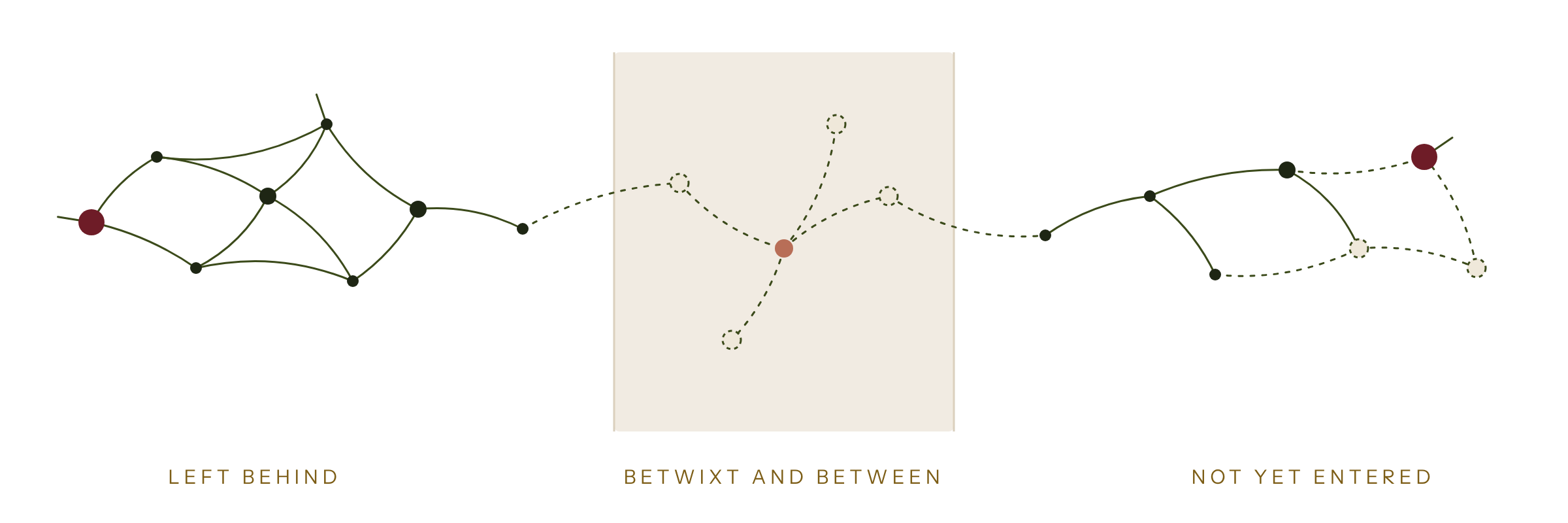
Liminality describes the experience of being between what was and what comes next. In anthropology, the term refers to the transitional period in a rite of passage, when someone has left one position behind but has not yet entered another. The anthropologist Victor Turner called this being “betwixt and between.” It is a time when familiar rules and expectations become less certain, and different possibilities come into view.
The concept also speaks to our present moment. Across societies, established ways of understanding the world are being questioned, while institutions and communities confront the enduring consequences of history. The past does not simply disappear. Its legacies persist in the stories we tell, the categories we use, and the institutions that shape whose experiences are recognized, whose voices are heard, and who belongs. Periods of transition can open possibilities for change, but they can also preserve existing inequalities or create new forms of exclusion.
Schools, museums, and public institutions are central to these processes. They shape how we understand history and its continuing effects, which perspectives are made visible, and how people understand their place in society. They can reinforce inherited assumptions or create opportunities to question them and imagine alternatives.
For Studio Liminal, liminality describes both the world in which we work and the approach we bring to it. We ask what persists, what changes, and under what conditions. Through research and education, we help institutions examine these questions and turn critical understanding into informed practice.
Why Liminal?
“The old is dying and the new cannot be born.”
Schools, museums, and public institutions are confronting some of the defining questions of our time. How do we teach difficult histories in increasingly polarized societies? How do power and inequality shape whose knowledge is valued, whose voices are heard, and who belongs? What happens when digital technologies and artificial intelligence reshape how we learn, understand the world, and relate to one another?
These questions are deeply connected, but institutions are often expected to address them through separate programs, policies, and initiatives. We bring anthropology, sociology, education, Holocaust and genocide studies, and the arts into conversation with the knowledge and experiences of educators, cultural practitioners, and communities.
Our work connects critical inquiry with practical action. We help institutions examine the structures and assumptions shaping their work, develop educational approaches, and navigate complex social questions. Rather than offering ready-made solutions, we work with our partners to develop responses that are intellectually rigorous, grounded in their contexts, and attentive to the possibilities for change.
Connecting the questions of the 21st century
An intellectual piazza
In Italian towns, the piazza is the heart of public life. It belongs to no one and to everyone. Children play there while their grandparents argue about politics; markets come and go; people gather to celebrate and to mourn. Difference there is not a problem to be managed. It is simply what public life is made of.
We imagine studio liminal as an intellectual piazza: a place for inquiry, disagreement, experimentation, and collaboration, where research is tested in conversation rather than handed down. A piazza is only public if everyone can enter it. That is why, alongside our commissioned work, we take on pro bono projects, so that research, dialogue, and learning are not reserved for institutions with substantial resources.